
Sapphire GTO by Michael Watts for Guitar Magazine

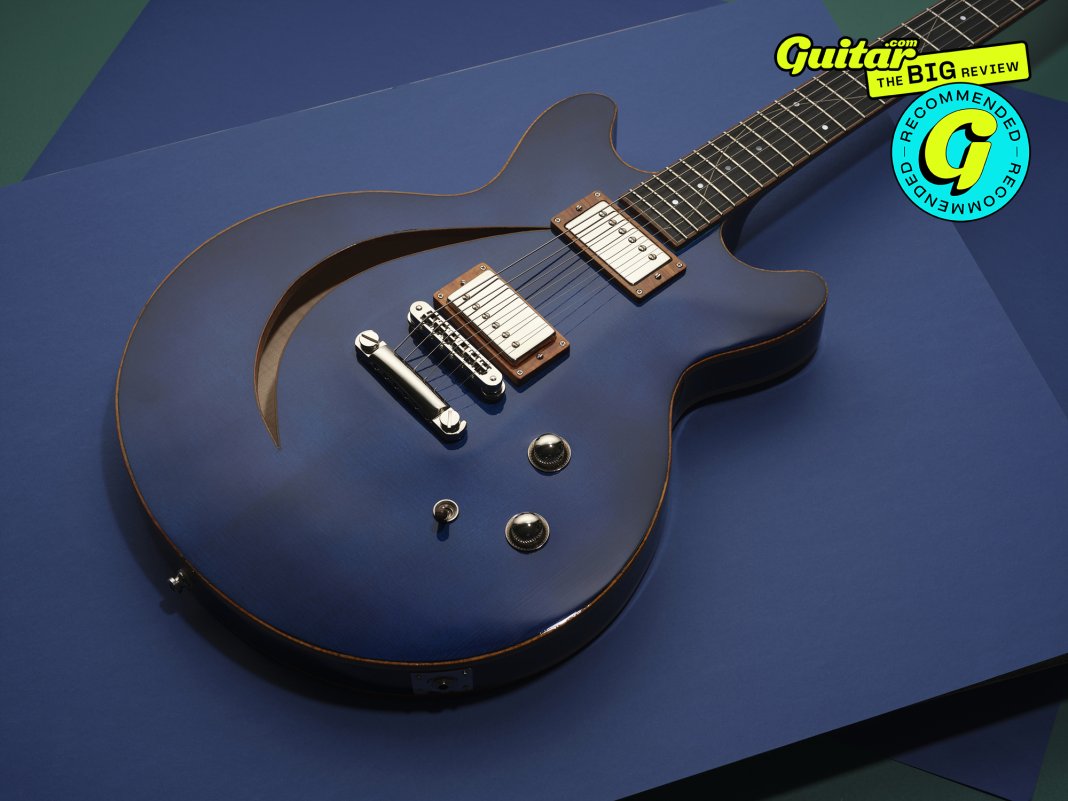
James Collins Sapphire Signature GTO – a eye-catching hollowbody guitar that showcases some of the best of boutique British luthiery
This high-priced but extremely high-end electric might look like an ES, but a closer inspection reveals a truly different and unique hollowbodied instrument – and not just because of the soundhole.
Although the history of the electric guitar is a story of mass production, there is a global community of luthiers who specialise in individual instruments made by hand. One of these is James Collins – a graduate of the prestigious Galloup School of Guitar Building and Repair – who builds a selection of solid and semi-hollow electric instruments from his workshop in East Sussex UK. This deep blue Sapphire Signature GTO model being a prime example of his top-of-the-range offering.
How is this different from other ES-style guitars?
A double-cutaway ES-style guitar with a dramatic swept crescent F-hole on the bass side, the GTO Sapphire is not your average Gibsonclone. Yes, you have a 24.75” scale and a pair of humbuckers (more of which later) but the construction is very different.
The body is made of book-matched flamed maple (not laminate) and what appears at first glance to be a spruce centre block is in fact an integral part of the hollowed-out body and instead of the traditional bent maple top seen on Gibsons and Gretsches for decades, we have a hand-carved soundboard of European spruce. This takes us firmly into real Gibson/D’Aquisto archtop territory. Very interesting.
This cobalt blue instrument was built in tribute to the legendary archtop guitar luthier Steve Grimes – in particular the Jazz Laureate that Grimes created as part of the much-vaunted Blue Guitar Collection commissioned by the late super collector Scott Chinery in the 1990s and now under the stewardship of The Archtop Foundation USA.
As such the whole instrument is finished in deep blue nitrocellulose (not the legendarily volatile Mohawk lacquer no. 520-4146 that ennobled all but one of the 22 guitars Chinery commissioned) and the hand-made binding, switch tip and pickup surrounds are curly Hawaiian Koa as a further tribute to the beautiful island of Maui where Grimes makes his masterpieces.
The glued-on neck is also made from flamed maple – there’s a natural finish stringer of flamed maple running the whole length of the guitar which culminates in an inset laser-engraved coin on the back of the headstock with the instrument’s serial number. You don’t see that every day.
There’s an ebony fretboard with a delicate maple sound wave inlay and mother-of-pearl microdot position markers in between the medium frets. Intriguingly the neck joins the body at the 18th fret rather than the 16th.
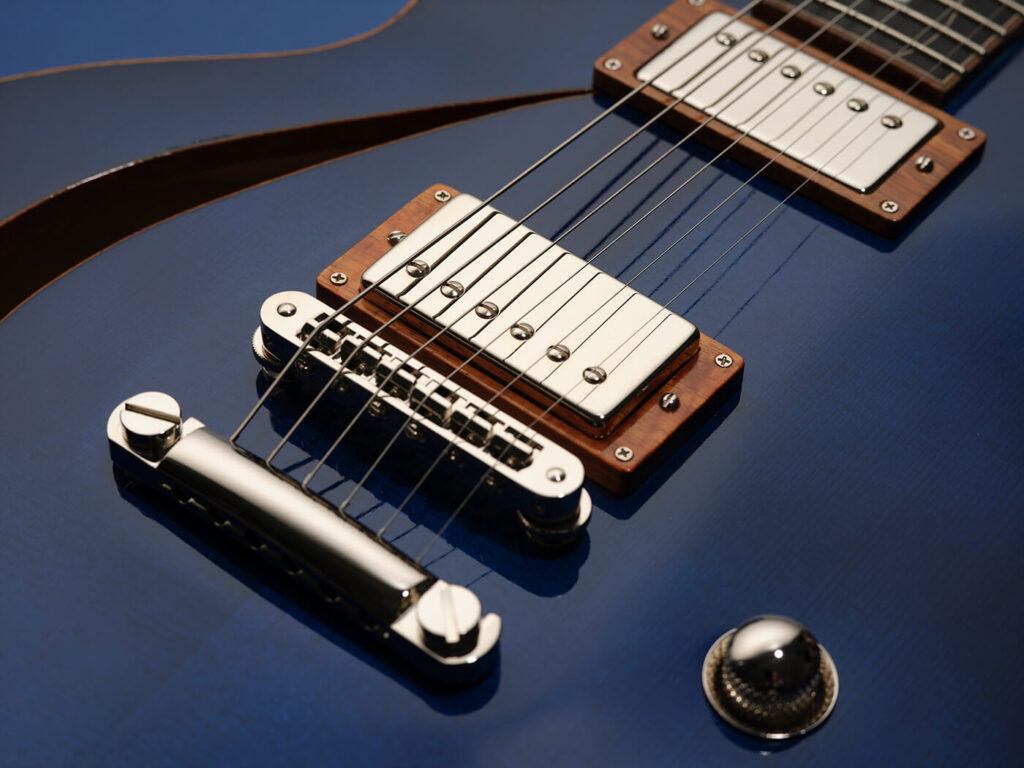
The hardware is all high quality, from the nickel Grover machine heads to the Tone Pros bridge. The controls are a simplified arrangement of single volume and tone controls – these have been carefully recessed into the body of the instrument. It’s a sophisticated approach.
Flipping the blue beast over gives me a chance to admire the flamed maple control cavity cover which is perfectly cut from the back. This is a nice touch, and well executed. It’s almost a pity that it hides the elegant wiring from view.
Although Collins will fit any pickup that a client prefers, this guitar features a pair of custom humbuckers wound in-house. This guitar is straight – no chaser, but coil taps and other wiring options are available. It’s time to plug in.

How Does The James Collins GTO Sound?
Plugging into an old Cornford Hurricane for a family friendly good time I get immediate results. Part ES-355, part L5, it’s the sort of vocal and articulate lead voice that is the holy grail for the modern jazz/blues player. Anything from Larry Carlton to Robben Ford and Jocelyn Gould – this guitar covers a lot of ground on the neck pickup alone.
The in-between sound has more bite to it than the average ES model. It may have a little too much chunk for the funk but a compressor will push it through the mix nicely. If you want to go properly spindly you can always arrange a coil-tap with James himself.
The bridge humbucker takes us straight to soul/R&B territory. Think David T. Walker, Cornell Dupree and Eric Gale (not Gales – though he’d probably dig this too). It’s particularly delicious with a slice of wah-wahpedal as you ease into those expensive chords. There’s a lot of sustain on tap here too. The whole instrument seems pent up and ready to deliver.
Speaking of which – even though the Collins GTO is intended as a sophisticated clean sound machine so was the Les Paul and look what happened there. With this in mind I subject the GTO to a line of dirt boxes including a Vemuram Jan Ray, a Crowther Hot Cake and a Bigfoot Engineering King Fuzz.
Most players will probably stop at a gentle overdriven clip but it’s good to know that this guitar will rise to the moment if you decide to evil it with some fuzz. Does it feel wrong? A little – but in a good way. The results are an eye-opening good time.
That rich and sophisticated voice translates into a full overdriven sound packed with delicious overtones. Individual notes jump out of cluster chords like an acoustic guitar and it’s such a joy to hear sustained ideas spiralling off into life-affirming harmonic feedback, controllable by the player’s fingers alone.
One thing that makes an immediate impression is the fact that although the guitar feels superbly slinky the strings feel thicker. Yep, it’s strung with 11s but the playability remains excellent throughout – even the stylistically controversial “boomer bends” can be executed without leaning in too hard.
As the absolute top of the James Collins range – the Sapphire Signature GTO involves a huge amount of work and the thought-provoking price tag is indicative of this fact. Every aspect of this guitar, from the woods used (cocobolo, walnut and even ebony are among the myriad options available for the soundboard) to the hardware – including hand-buffed curly Koa pickup surrounds – can be customised to the owner’s needs.
We truly are living in a golden age of guitar luthiery and the James Collins Sapphire Signature GTO is a prime example.
April 05, 2024
Image: Adam Gasson for Guitar.com

James Collins Signature GTO
The UK has been home to some of the world’s foremost luthiers over recent years, and this stunning new instrument is a shining example of the very best of their work.
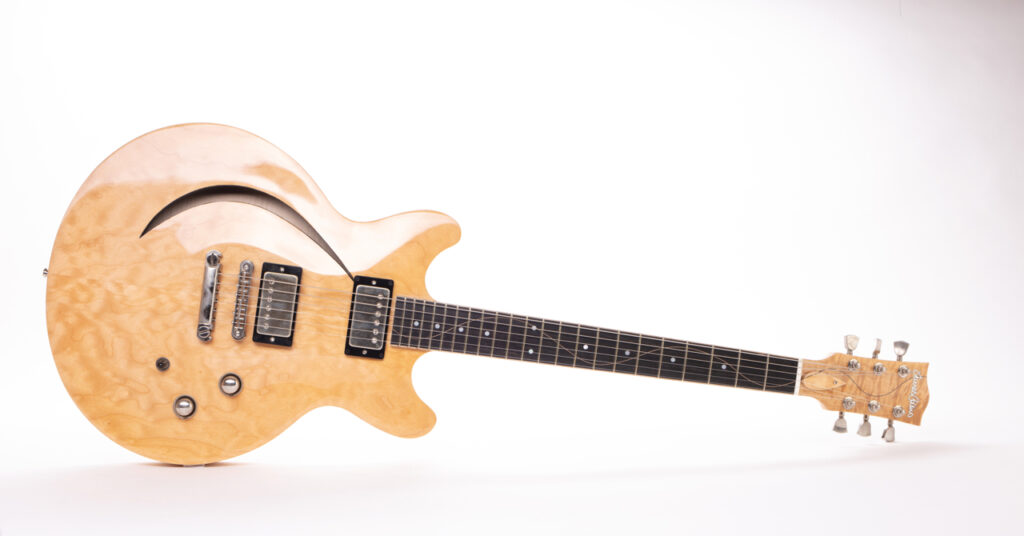
The Signature GTO was developed with input from the artist Ashton Sellars, and is the flagship instrument in the James Collins stable. A double cutaway, it is longer, and at 15”, a wider-bodied guitar than its sister instruments. It comes with a solid AAA flame maple body that has been hollowed out and given a striking hand carved quilted maple cap featuring a crescent ‘f’ hole that reflects the ‘m.o.p. wave’ detailing on the fretboard. The quilted maple theme has been continued on the headstock with the facia being given a piece of quilted maple giving this instrument a look like no other. The truss rod cover is also in quilted maple, leaving the six individual nickel Grover machine heads looking a little simplistic beside the sumptuous woods (although they are the perfect match for the hardware on the body.
The Flame Maple neck has been expertly set into the body with a hand-set mortice-tenon joint. Atop the medium C shape neck is a marble like ebony fretboard headed by a 43mm bone nut and sporting 22 medium frets. As previously mentioned, there is a fine wave motif that runs the entire length of the fretboard, while 5mm mother of pearl dots and maple binding with 2mm side markers complete the picture.
Down at teh sharp end are two Bare Knuckle “Stormy Monday” humbuckers in plain enamel calibrated Almico II. These are connected to two GTC55k Pots, treble bleed together with a Jensen Paper & Oil Cap for superb tone control. Tone and Volume control are dialled in with the recessed knurled nickel dome knobs. Pickup selection is by way of a 3 way toggle switch with a solid ebony tip. Body hardware is completed by a pair of Grover Quick release locking strap buttons. a fully adjustable Tone Pro Nashville TuneOMatic bridge and stop tail piece. The Signature GTO has been given a pure nitrocellulose finish to optimise teh inherent tonal characteristics of the woods.
The Signature GTO is not a light guitar, its weight reminding yours truly of the Gibson Les Paul. The neck is fast and easy, but purely from a personal perspective, it’s too deep for me. I can understand the need for increased mass, as this help with the sustain and tonal qualities, and playing this instrument acoustically immediately tells you that this is some guitar!
Plugged into teh house DV Mark Little Jazz amp, the natural sonic qualities together with the lively Baer Knuckle pickups deliver a striking response. Teh treble bleed together with the Jensen Cap brings superb tone control, offering the player hard raw raspy tones right through to a sensuous, silky mellow tone that cries out for an emotive melody line.
Coming in a hardshell shaped case with four latch locks together with a plush lined padded interior with accessory pocket, this was never going to be a cheap instrument (prices are around £5499). But as the saying goes “you get what you pay for” which is certainly the case with this Signature GTO.


Mini Archtop with noble ingredients
Sussex Life Magazine.
Sussex Ash GTS. Local Woods Challenge, Holy Grail Show, Berlin

Flame Maple GTB
Grand Gtrs Germany

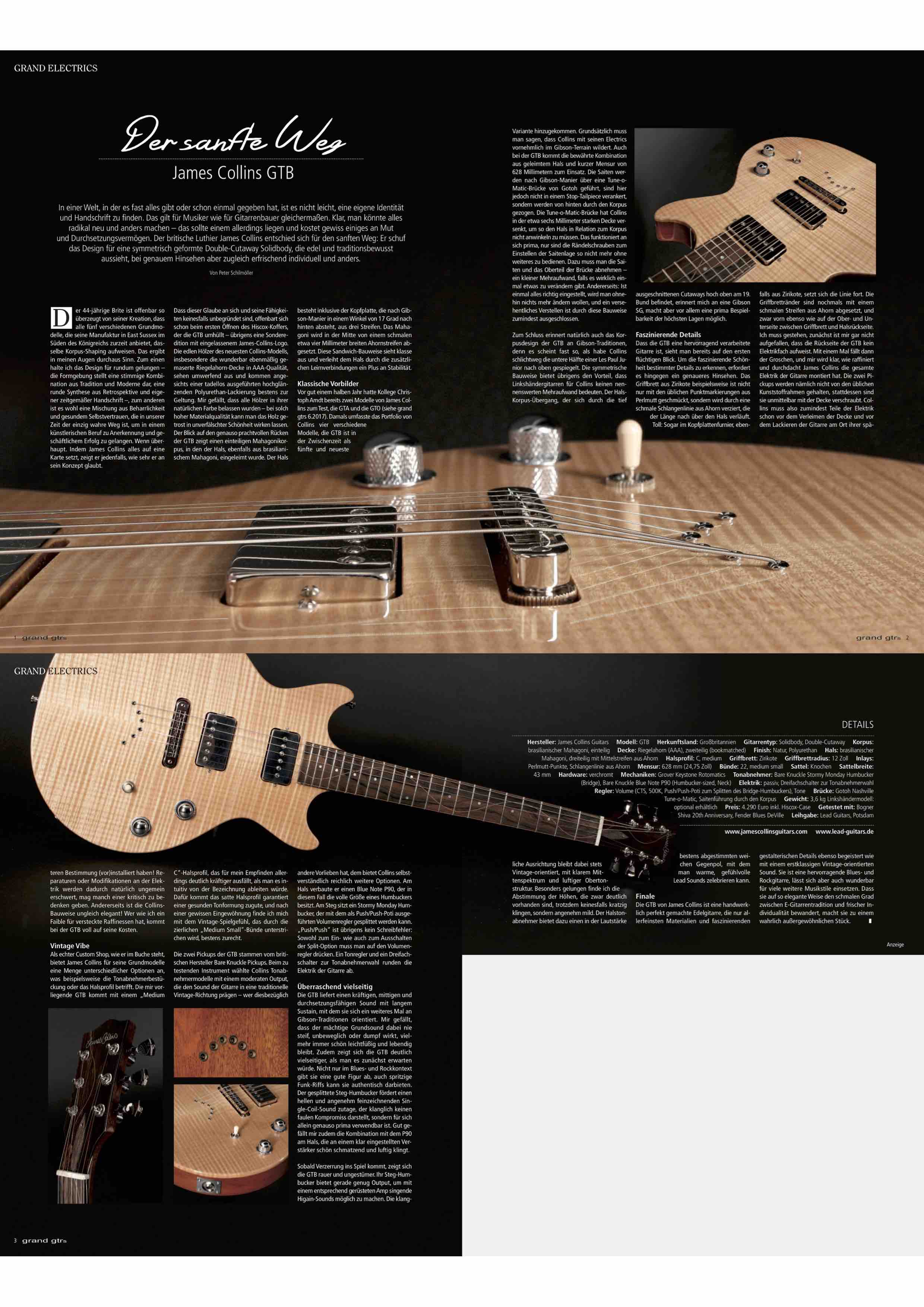
In a world where there is almost everything or has ever existed, finding your own identity and handwriting is not easy. This applies to musicians as well as to luthiers alike. Sure, you could do everything radically new and different – but that should be one and certainly costs a lot of courage and assertiveness. The British luthier James Collins opted for the gentle path: He created the design for a symmetrically shaped double-cutaway solid body, which looks noble and traditional, on closer inspection but at the same time refreshingly individual and different.
The 44-year-old Briton seems to be so convinced of his creation that all five different basic models that his manufactory currently offers in East Sussex in the south of the Kingdom have the same body shaping. That makes sense in my eyes. On the one hand, I think the design is completely successful – the design represents a harmonious combination of tradition and modernity, a round synthesis of retrospective and its own contemporary style – and, on the other hand, it is probably a mixture of perseverance and healthy self-confidence which in our time is the only true way to gain recognition and business success in an artistic profession. If any. Anyway, by putting everything on a map, James Collins shows how much he likes his concept beliefs.
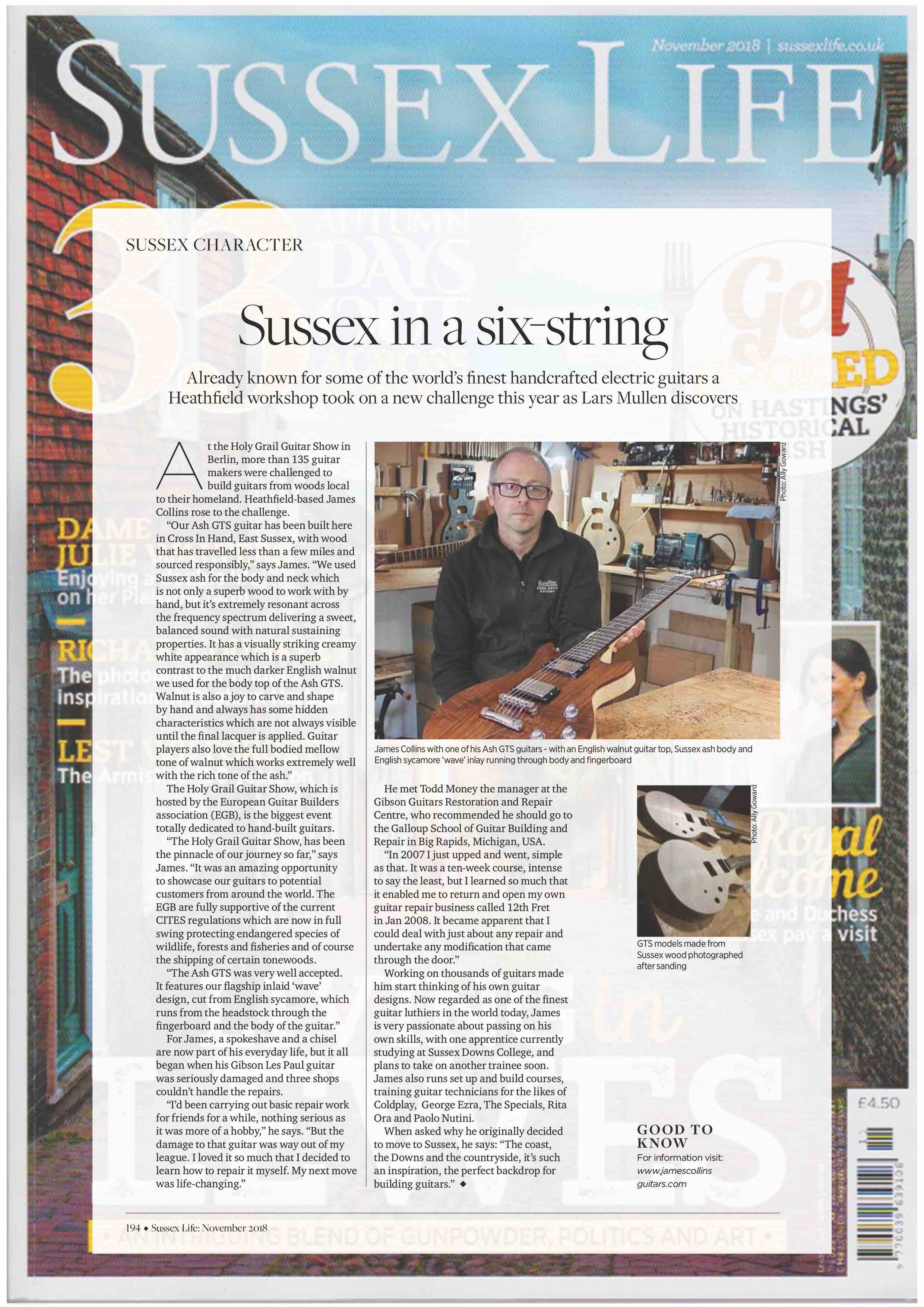
The fact that this belief in himself and his abilities is by no means unfounded is already evident when the Hiscox suitcase, which encases the GTB, is opened for the first time – incidentally, a special edition with an inset James Collins logo. The noble woods of the latest Collins model, in particular the wonderfully even-tempered AAA-quality flame maple top, look stunning and come into their own in the light of a perfectly executed high-gloss polyurethane paint finish. I like the fact that all woods have been left in their natural color – with such a high quality of material, the wood can be left to dry in unadulterated beauty. The view of the equally magnificent back of the GTB shows a one- piece mahogany orb, into which the neck, also made of Brazilian mahogany, was glued. The neck consists of three strips, including the top plate, which protrudes backwards at a 17-degree angle in a Gibson manner. The mahogany is placed in the middle of a narrow strip of maple about four millimeters wide. This sandwich construction looks great and adds extra stability to the neck thanks to the additional glue joints.
Classic role models
Just over half a year ago, colleague Christoph Arndt had already tested two models by James Collins, the GTA and the GTO (see grand gtrs 6.2017). At that time, the portfolio of Collins included four different Models, the GTB is in the meantime as fifth and newest Variant added. Basically, one has to say that Collins poaching primarily in the Gibson terrain with his Electrics guitars. The proven combination of a glued neck and a short scale of 628 millimeters is also used in the GTB. The strings are led Gibson-style over a Tune-o-Matic bridge by Gotoh, but here are not anchored in a stop tailpiece, but are pulled from behind through the body. The Tune-o-Matic bridge was lowered by Collins in the top, which is about six millimeters thick, so as not to have to bend his neck in relation to the body. This works great in itself, only the thumbscrews for adjusting the position of the strings are no longer easy to operate. To do this, you have to remove the strings and the top of the bridge – a small extra effort if there really is something to change. On the other hand, once everything has been set correctly, you will no longer want to change anything, and accidental adjustment is at least precluded by this method of construction.
Finally, of course, the body design of the GTB recalls Gibson traditions, because it almost seems as if Collins simply mirrored the lower half of a Les Paul Junior upwards. Incidentally, the symmetrical design offers the advantage that left-handed guitars do not mean much extra work for Collins. The neck-body transition that cuts through the deep cutaway cutaways high up on the 19th fret, reminds me of a Gibson SG, but above all makes a great playability of the highest frest possible.
Fascinating details
The fact that the GTB is an excellently processed guitar can already be seen at first glance. In order to recognize the fascinating beauty of certain details, however, it requires a closer look. The Ziricote fingerboard, for example, is not only adorned with the usual mother-of- pearl markings, but is also decorated with a narrow maple serpent line runs lengthwise over the neck. Great: even in the top plate veneer, just if from Ziricote, the line continues. The fingerboard edges are once again set off with a narrow strip of maple, in front as well as on the top and bottom side between the fretboard and the back of the neck. I must confess, at first I did not notice that the back of the GTB has no electrical compartment. All of a sudden, the penny falls, and I realize how cleverly and thoughtfully James Collins has mounted the entire electrical system of the guitar. The two backups are not held by the usual plastic frame, instead they are bolted directly to the top. Collins must therefore at least dispose of parts of the electrical system before the gluing of the ceiling and before painting the guitar at the location of its later have been installed before! Of course, repairs or modifications to the electrics are made extremely difficult, and many may be critical. On the other hand, the Collins design is unequally elegant! Those who like me have a penchant for hidden sophistication will get their money’s worth at the GTB.
Vintage vibe
As a true custom shop, James Collins offers a variety of options for his basic models, such as the pickup or neckprofile. The present GTB comes with a “medium C “profile, which, however, seems to me to be significantly stronger than one would intuitively derive from the name. For this, the full neck profile guarantees a healthy tone shaping, and after a certain acclimation I find myself with the vintage feel, which is emphasized by the delicate “Medium Small” frets, very well.
The two pickups from GTB come from the British manufacturer Bare Knuckle Pickups. For the instrument being tested, Collins chose a moderately-priced model of tonal samplers that shape the sound of the guitar in a traditional vintage direction – who in this regard.
Of course, Collins offers plenty of other options. At the neck he built a Blue Note P90, which in this case has the full size of a humbucker. There is a Stormy Monday Humbarcker in the bridge, which can be split with the push-push potentiometer. Incidentally, “push / push” is not a spelling error: you must press the volume knob to turn the split option on or off. A tone control and a triple switch for picking the pickups complete the electrical system of the guitar. Surprisingly versatile The GTB delivers a powerful, mid-range and assertive sound with long sustain, once again based on Gibson traditions. I like the fact that the powerful basic sound never seems stiff, immobile or dull, but always remains light-footed and lively. In addition, the GTB is much more versatile than you would expect it at first. Not only in blues and rock context, she gives a good figure, even sparkling funk riffs, they can authentically present. The split bridge humbucker brings out a bright and pleasant fine-grained single-coil sound, which does not sound like a lazy compromise, but can be used just as well on its own. I also like the combination with the P90 on the neck, which sounds nicely smacking and airy on a clearly set amplifier.
As soon as distortion comes into play, the GTB becomes rougher and more impetuous. The bridge humbuckeroffers just enough output to make singing hi-gain sounds possible with a suitably equipped amp. The sound alignment always remains vintage-oriented, with a clear midrange and airy overtone structure. I find the tuning of the heights particularly successful, which are clearly present, nevertheless do not sound scratchy, but pleasantly mild. The Halston customer offers one in volume well-balanced, soft antipole, with which you can celebrate warm, soulful lead sounds.
Final
The GTB by James Collins is a classically crafted stainless steel, made of only the finest materials and fascinating design details as well as a first-class vintage- oriented sound. It’s a great blues and rock guitar, but it’s also great for many other styles of music. The fact that she so elegantly masters the subtle difference between electric guitar tradition and fresh individuality makes her a truly extraordinary piece.
Holy Grail Show, Berlin. Review
Guitare Extreme France
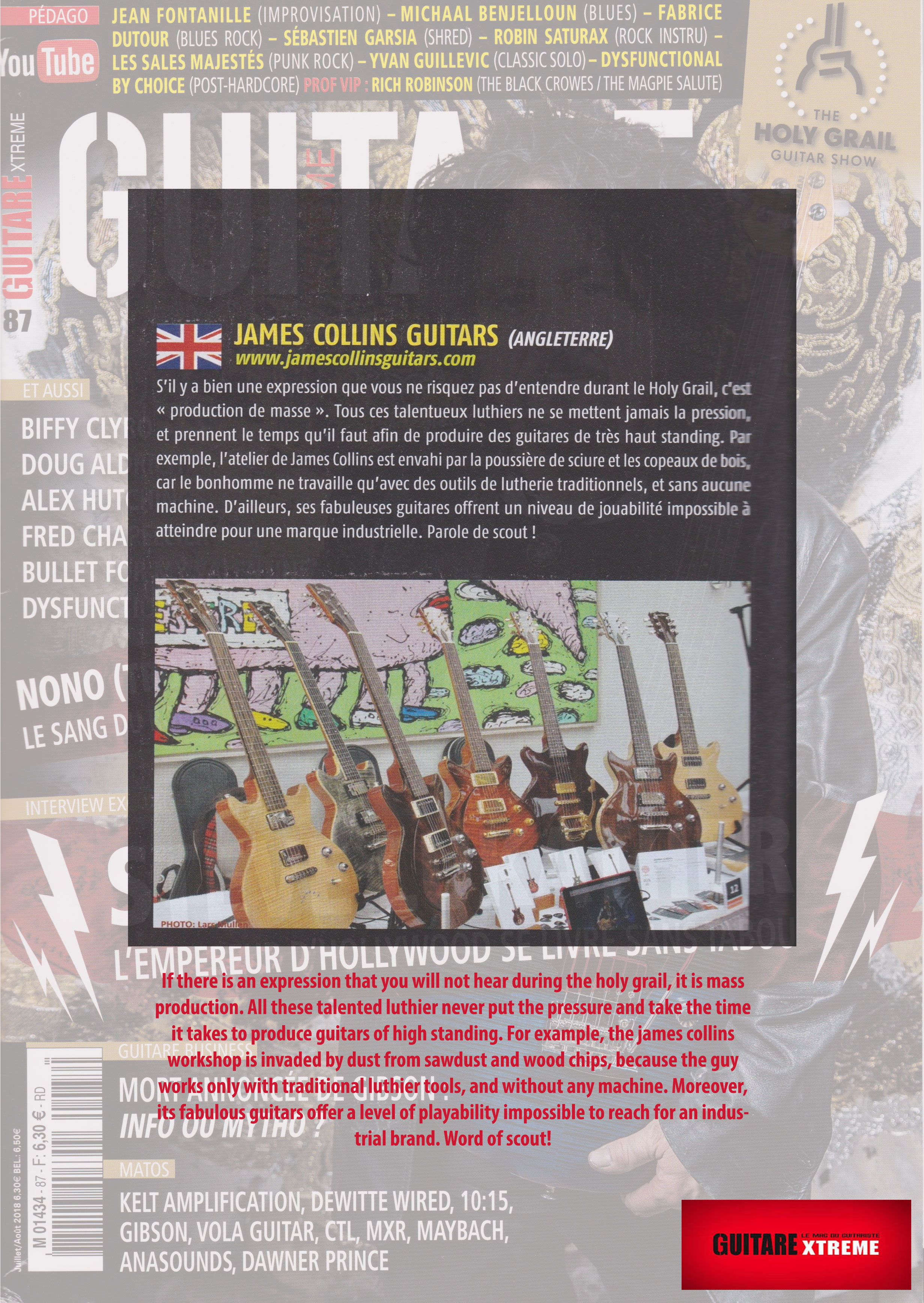
Matching Flame Maple GTB’s
Guitarist Magazine

Redwood GTO & Cocobolo GTA
Grand Gtrs, Germany




James Collins, a guitar engineer from Sussex, may have heard so few. Or you can change it, as I do, with the US manufacturer Collings. In doing so, the man builds true cuttings for the friends of the more glamorous department: welcome to “Collins British Delicatessen”.
Text by Christoph Arndt, Pictures by Andreas Huthansl
Z for test I received with the Cocobolo GTA and the Redwood GTO two interesting models. Currently, he offers four double-cutaway guitars with flat or vaulted ceilings, which to the names GT, GTA, GTS and GTO. Anyone who now thinks about Italian sports cars is right. As James told me in the phone interview, he not only has a passion for Ferrari, but could also use their model names without any appeal from the famous Automarke. Industry newcomer James Collins is one of the few authorized Gibson repairmen in the United Kingdom. You have to be an excellent guitar builder, so you can get such an award.
In 2011 he began with the construction of own guitars, the company Collins Guitars exists since 2015. At present, 15 to 20 instruments leave their workshop every year, with a long-term goal being 48 per year, which would be one copy per month of each model. At present, a full-time employee and a trainee are supporting the small company, which should then probably be expanded. Despite the small number of pieces, James offers a wide range of options, which means that he is in no way inferior to a custom shop. There will be no more models for the time being, the four cover the entire catalog of options with the broadest possible catalogs. Condition: The basic styling must fit, as James Collins’ design style polarizes perfectly. After all, there are plenty of boredom on the market.
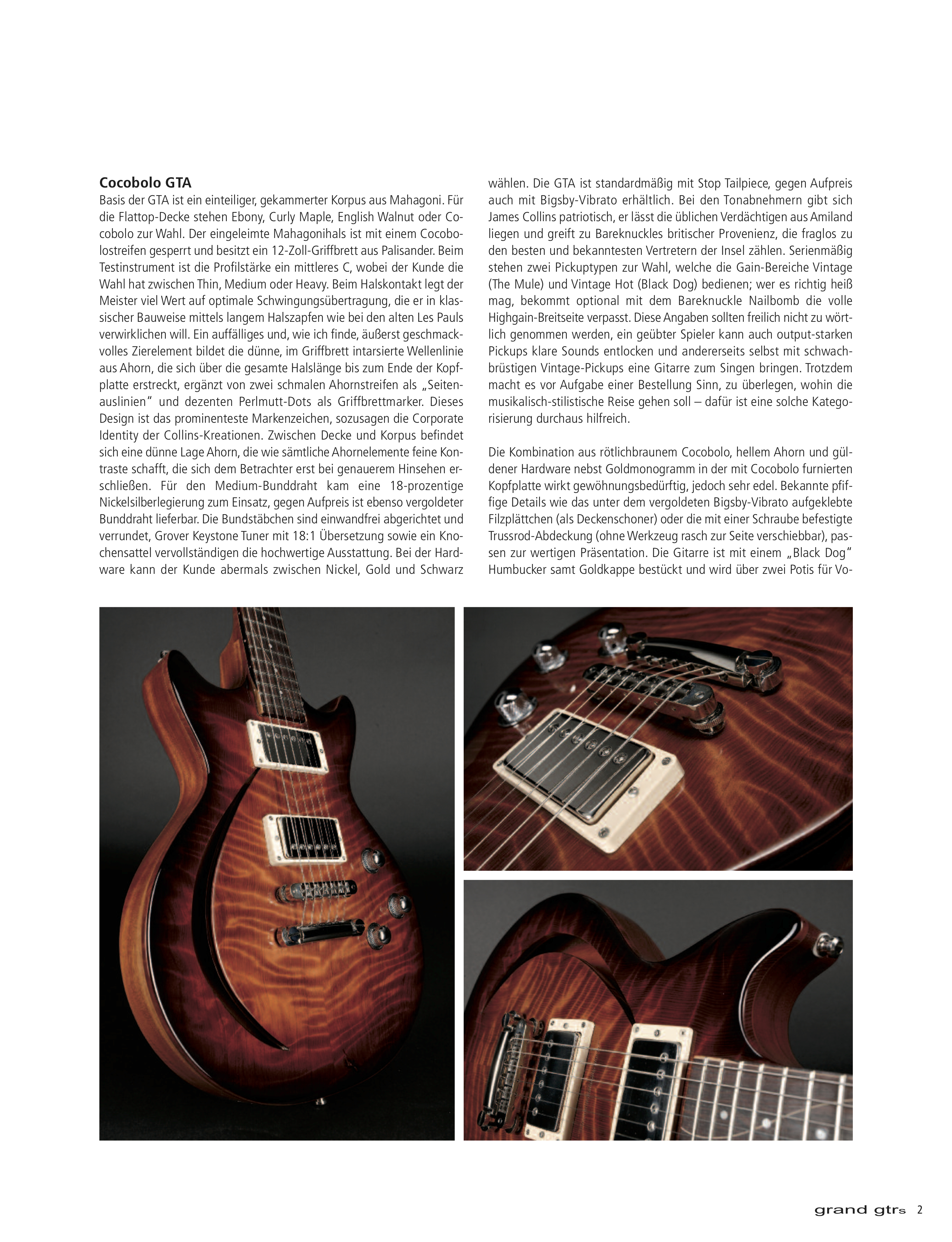
The basis of the GTA is a one-piece, mahogany body. Ebony, Curly Maple, English Walnut or Cocobolo are available for the flattop ceiling. The glued mahogany neck is locked with a cocobolo looper and features a 12 inch rosewood fretboard. In the test instrument, the profile thickness is an average C, with the customer choosing between Thin, Medium and Heavy. In the case of the neck contact, the master attaches great importance to optimal vibration transmission, which he wishes to realize in classical design by means of a long throat as in the case of the old Les Pauls. A striking and, as I find, extremely tasteful ornamentation is the thin maple in the fingerboard, which extends over the entire neck length to the end of the head plate, supplemented by two narrow maple strips as “side outlines” and subtle mother-of-pearl dots as fingerboard markers. This design is the most prominent trademark, so to speak, the corporate identity of the Collins creations. Between the ceiling and the corpus is a thin layer of maple, which, like all the map elements, creates fine contrasts, which are opened to the observer only on closer inspection. An 18% nickel-silver alloy was used for the medium bundle wire, while a gilded bundle wire was also available for an additional charge. The cranks are flawlessly dressed and rounded, the Grover Keystone Tuner with an 18: 1 ratio and a bone saddle complete the high- quality equipment. In the case of the hardware, the customer can also choose between nickel, gold and black.
The GTA is available as a standard with stop tailpiece, for an extra charge also with Bigsby vibrato. James Collins is patriotic with the pickups, leaving the usual suspects from Amiland, picking up on Bareknuckle’s British provenance, which is undoubtedly one of the best and most famous representatives of the island. There are two pickup types available for the vintage (The Mule) and Vintage Hot (Black Dog) gain ranges; who likes it really hot, gets optionally with the Bareknuckle Nailbomb the full Highgain- Breitseite missed. This information should not be taken too literally, a practiced player can also elicit clear sounds from powerful pickups, and on the other hand, even with weak-brimmed vintage pickups, make a guitar sing. Nevertheless, prior to assigning an order, it makes sense to consider where the musical-stylistic journey should go – for this reason such a categorization is helpful.
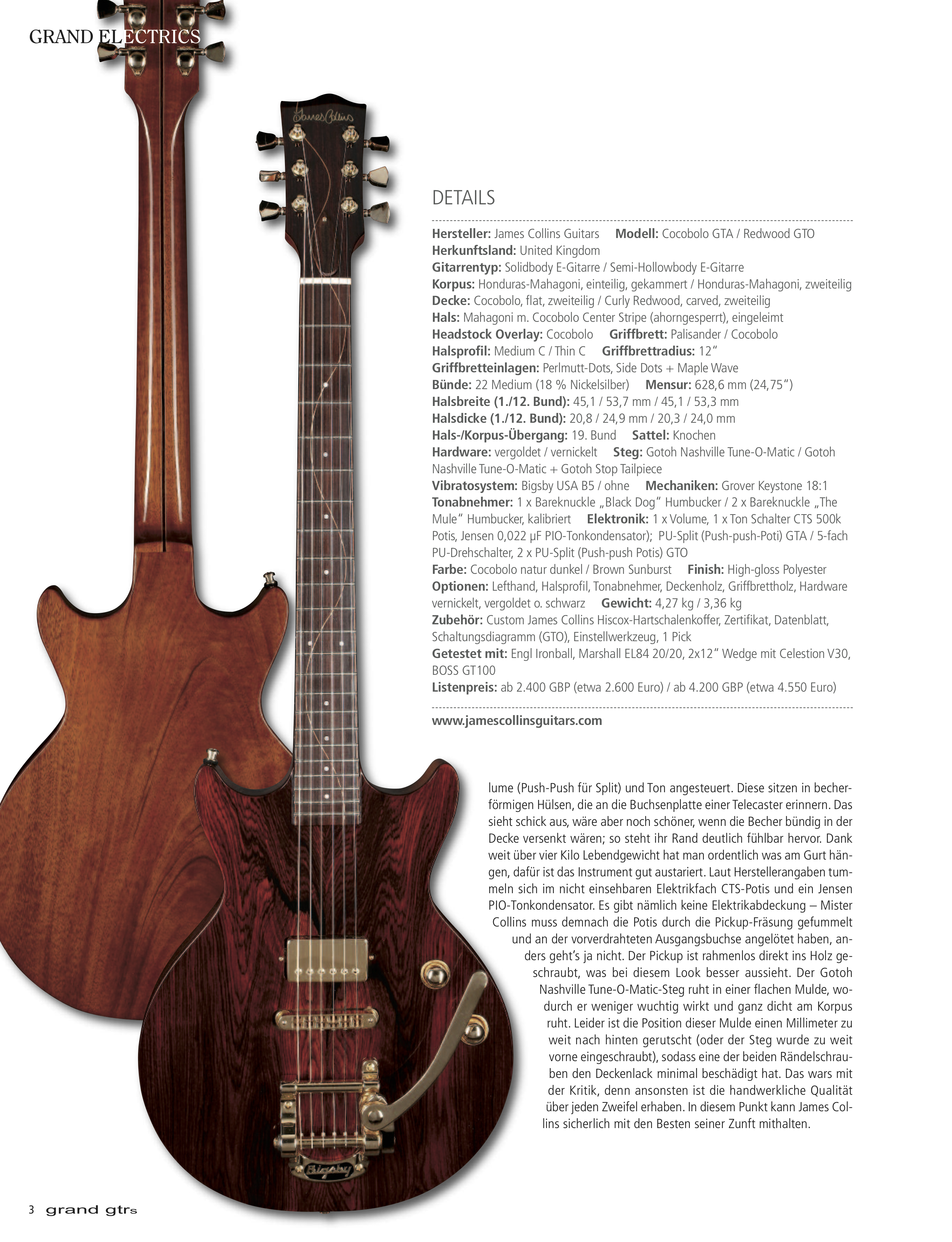
The combination of reddish-brown cocobolo, bright maple and gold hardware along with gold monograms in the Cocobolo veneered head plate is very popular, but very elegant. Well-known details, such as the felt plate (glued under the gilded Bigsby vibrato) (as a ceiling fan) or the Trussrod cover (screwed to the side without a tool), fit to a high-quality presentation. The guitar is equipped with a “Black Dog” humbucker with gold cap and is equipped with two potentiometers for Volume (push-push for split) and sound- controlled. These are housed in cup-shaped sleeves, which are reminiscent of the sockets of a telecaster. This looks chic, but would be even more beautiful if the cups were sunk in the ceiling; its edge is clearly felt. Thanks to far more than four kilos of live weight, you have a good hang on the harness, but the instrument is well balanced. According to the manufacturer, CTS potentiometers and a Jensen PIO sound condenser are tumbling in the non- visible electrical compartment. There is no electrical cover – Mister Collins must have fumbled the pots by the pickup-milling and soldered to the prewired output socket, it is not. The pickup is framelessly screwed directly into the wood, which looks better with this look. The Gotoh Nashville Tune-O- Matic bridge rests in a shallow trough, making it less bulky and very close to the body. Unfortunately, the position of this trough has slipped one millimeter too far backwards (or the bar has been screwed too far forward) so that one of the two knurled screws minimally damaged the top coat. That was with the criticism, because otherwise the craftsmanship is beyond any doubt. At this point, James Collins certainly with the best of his guild.
Redwood GTO
The GTO is the only semihollow in the program. A beautifully carved Curly Redwood cover with a crescent-shaped “F-hole” decorates a second mahogany body in a dark brown sunburst finish with a sustain block that does not extend over the entire length. The hardware is completely nickel-plated. In contrast to the massive GTA, it seems almost 3.3 kilograms like a flyweight. Here, the neck profile is installed in the narrowest variant “Thin” and the fingerboard consists of Cocobolo. Many features of the GTA are found again at the GTO, so I would just like to look at the differences. In addition to the design, these mainly concern pickups and circuitry. The two calibrated “The Mule” humbuckers, which are set in cream-colored frames, are both splitable and are controlled by a volume and tone controller as well as a five-stage rotary switch for the pickup selection. They can be called individually and together (serial, parallel as well as out-of-phase), but can not be individually controlled. This, in conjunction with the splitting options, nevertheless promises an enormous sound diversity. Small vermouth drops: The electrical cover has different gap dimensions, which is certainly due to the factor of manual work.
Double play
Despite its minimalist features, the GTA offers a fine selection of sounds, ranging from crystal-clear pearling single note pickings to snappy crunch sounds to tubeless lead sounds. The controllers want to be operated wisely, only the “intermediate positions” bring the full potential of the instrument into effect. The “Black Dog” can grow not only snarling, but if necessary bark furiously! The homogeneity is very well-balanced, strings of the strings, there is truly joy. As far as the tonality is concerned, there is, as it were, a central- nasal basic characteristic, the frequency of which is higher than that of a Les Paul. This makes it a bit more difficult to find the sweetspot for a certain song, but that’s just the charm of such a guitar with just one pickup: you have to work more and listen carefully until all the sound controls on the amp are done the fine, then the mail goes off. The playability of the neck is excellent, only the transition to the corpus is too angular for me, the highest frets are thus for my rather narrow hands worse to hardly reach still.
The considerably more expensive GTO shows clear sound parallels to the GTA, whereby the 5-way switch opens up a rich universe of sounds, for which one should take time. Although the five positions are marked by mother-of- pearl inlays, a corresponding nose or similar is missing on the knob. After a while, the sound quickly identifies the position in which you are playing. Printable, focused lead sounds that are less deep, but more defined and more powerful than Les Paul, thin single-coil sounds that do not have any fender- eskes, quirky-hollow out-of-phase variations, and obey the possibility to split one or both pickups at the same time, impressively make clear, which abundance of sounds and nuances can be realized with two humbuckers. Like one of the characteristic basic sound of the GTO, everything is offered here, what the heart desires. Nice thing!
Summary
Pure craftsmanship, high-quality workmanship with minimal finishes, beautiful woods, first-class tonal qualities and an unmistakable styling characterize James Collins guitars. Great cinema, I am thrilled. Those who value all these qualities and dare to combine them visually with a dignified individuality can find more than just a find: a love for life could develop.
Redwood GTO by Lewis Turner
iGuitar Magazine
Cocobolo GTA
iGuitar Magazine

Flame Maple GTA
Guitar & Bass Magazine, UK

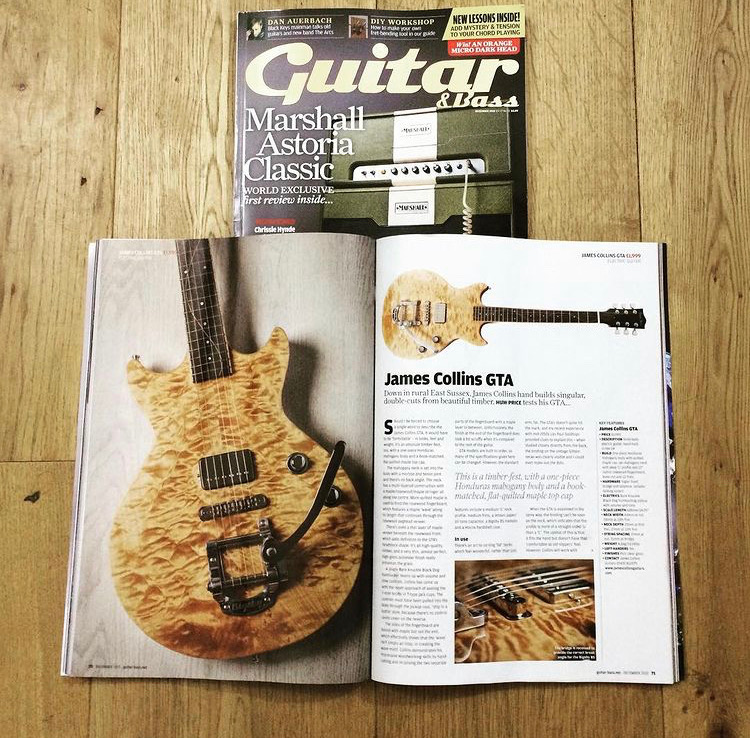
Quilt Maple GTS
Guitar Interactive Magazine

Electric guitars hand built in the United Kingdom
Click edit button to change this text.